ELECDURA NETWORK

Your Whole New Supply Chain For Heavy-Duty Parts
Whatsapp:
+86 18915027366
Phone:
+86 18915027366

144-1644
144-1644
OE-Equivalent Replacement Quality
IATF 16949 / ISO 9001 / CE / RoHS
50 pcs
7 - 15 Days
12 Months
144-1644
Caterpillar hydraulic systems using 144-1644 with confirmed machine serial number
Confirm 24v, connector, 1-1/16-12 cartridge with lead connector, seals and hydraulic circuit before installation.
| Quantity: | |
|---|---|
144-1644 is a 24V two position four way hydraulic solenoid valve for Caterpillar hydraulic systems using 144-1644 with confirmed machine serial number. Buyers should confirm the complete old marking, electrical version, connector, 1-1/16-12 cartridge with lead connector and hydraulic function before approving replacement stock.
Specification | Value |
|---|---|
Product Type | Two Position Four Way Hydraulic Solenoid Valve |
Primary Reference | 144-1644 |
Cross References | 144-1644 |
Electrical Version | 24V |
Working Pressure Reference | 350 bar |
Interface | 1-1/16-12 cartridge with lead connector |
Application Scope | Caterpillar hydraulic systems using 144-1644 with confirmed machine serial number |
MOQ | 50 pcs |
Delivery Time | 7 to 15 Days |
Warranty | 12 Months |
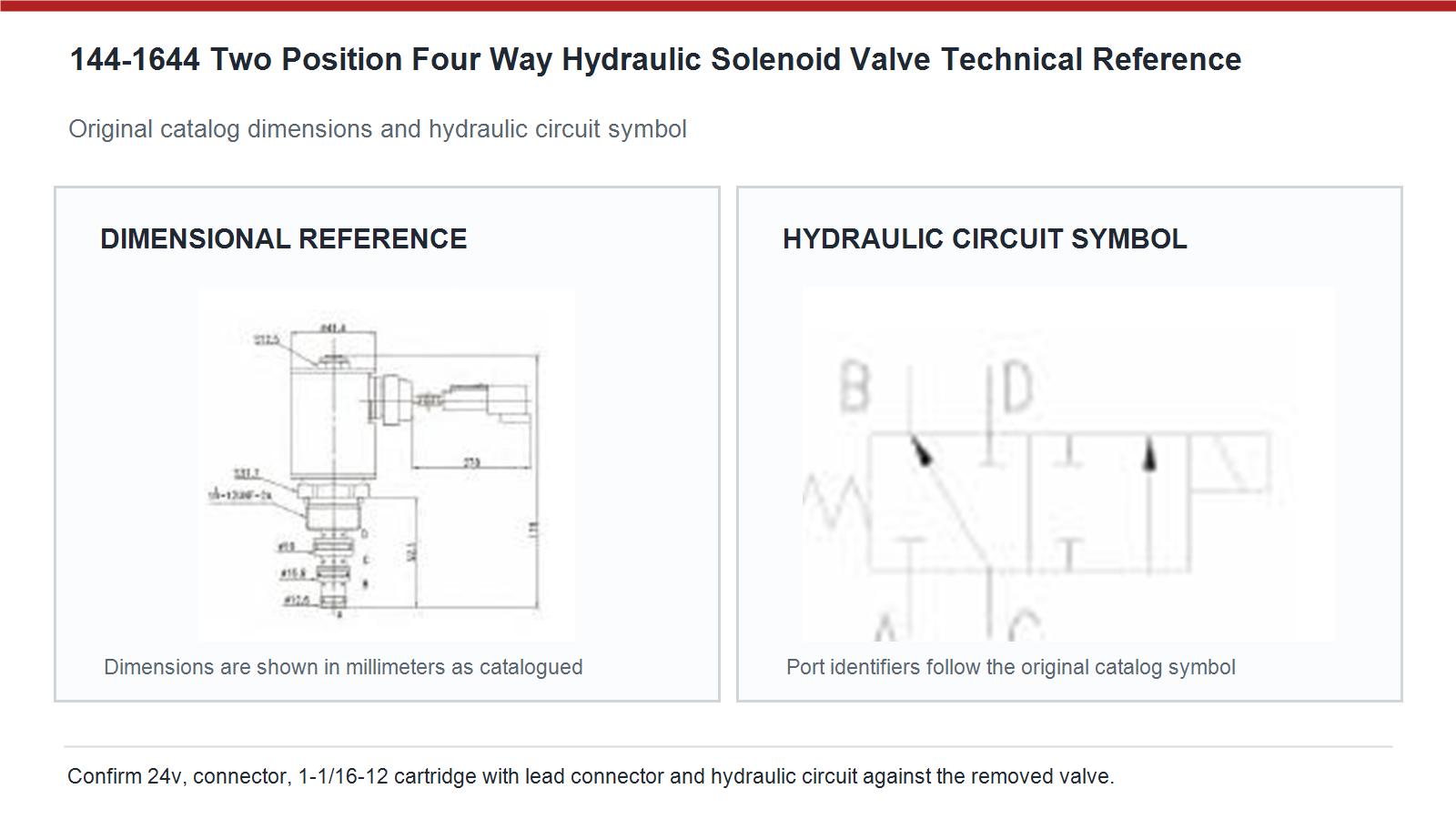
Use the original catalog dimensional reference and hydraulic symbol to compare the valve with the removed component and the machine schematic before purchase approval.
Complete every control point below before a sample or bulk order is released.
Approval Point | Buyer Review |
|---|---|
Reference | 144-1644 |
Electrical | 24V; verify at the loaded connector during the actual command |
Mechanical | Compare 1-1/16-12 cartridge with lead connector, cartridge length, seals and installed clearance |
Hydraulic | Confirm normal state, energized state and manifold port relationship |
Machine Evidence | Caterpillar hydraulic systems using 144-1644 with confirmed machine serial number |
Separate electrical command, cartridge movement and machine response so the actual wiring or hydraulic fault is not hidden by a parts replacement.
Observed Condition | Recommended Check |
|---|---|
No movement | Check loaded connector voltage, ground, controller command and coil resistance. |
Slow response | Inspect oil cleanliness, filter condition, viscosity and cartridge movement. |
Reversed response | Stop operation and compare normal and energized port logic with the original valve. |
External leakage | Inspect seals, cartridge surface, manifold bore and correct seating depth. |
Repeated heating | Confirm voltage, duty cycle, connector resistance and full magnetic movement. |
During contaminated hydraulic oil has been discovered, keep the verified reference, measurements and test result in the service record. Approve 144-1644 from the complete old valve marking, 24v electrical version, connector keying, 1-1/16-12 cartridge with lead connector, sealing lands and normal hydraulic state. A shared equipment model does not prove interchangeability because pump and manifold revisions can change during production. Send the machine model, serial number and clear removed part photos with the inquiry.
During a manifold bore shows possible wear, keep the verified reference, measurements and test result in the service record. Read the coil label first and measure voltage at the connector while the real machine command is active. The working reference for this page is 24V. Do not infer voltage only from battery count because converters, harness changes and mixed voltage fleets can create misleading assumptions. Record the verified value on the purchase order and incoming inspection label.
During a mixed voltage shipment reaches receiving inspection, keep the verified reference, measurements and test result in the service record. Two valves can share a coil diameter and connector yet use different cartridge lengths, metering notches, spring forces or port logic. In Caterpillar service, compare the full reference, manifold bore, installed depth, connector direction and hydraulic symbol. A valve that screws in but routes pressure differently can create weak response, reversed motion or continuous pump loading.
During a serial controlled overhaul is prepared, keep the verified reference, measurements and test result in the service record. Measure supply and ground at the loaded connector, then check coil resistance and verify that the controller is actually issuing the command. If electrical input is correct, inspect oil cleanliness, filter condition, cartridge movement and manifold contamination. Separate electrical command from hydraulic response before replacing another valve, otherwise a harness or blocked pilot passage may be missed.
During an emergency field repair is evaluated, keep the verified reference, measurements and test result in the service record. Check the printed reference and voltage against the purchase order, then sample connector keying, overall length, mounting interface, seal count and coil resistance. Keep voltage or suffix variants physically separated and traceable. For the first production lot, compare one unit with the approved old component before releasing the remaining quantity to warehouse stock or field service.
During a maintenance planner builds critical spare stock, keep the verified reference, measurements and test result in the service record. Compare the connector face, key position, pin count, latch direction and cable exit with the removed component. Also check whether suppression is built into the coil because this can affect controller diagnostics. Photograph the connector straight on beside a ruler and include the terminal condition in the RFQ, especially when several Caterpillar harness revisions are used in the same fleet.
During a seal leakage complaint is assessed, keep the verified reference, measurements and test result in the service record. The spring side of the circuit symbol defines what the machine does when electrical power is absent. That state can hold, unload, block or route pilot pressure, and the wrong choice may create movement or pump load at startup. Compare the original schematic with the catalog symbol and verify the safe normal condition before energizing the replacement in the machine.
Send the complete old valve marking, confirmed voltage, machine model and serial number, connector photos, interface dimensions and required quantity for a fitment focused B2B quotation.