ELECDURA NETWORK

Your Whole New Supply Chain For Heavy-Duty Parts
Whatsapp:
+86 18915027366
Phone:
+86 18915027366

25/104700
25/104700 / 25/MM6394
OE-Equivalent Replacement Quality
IATF 16949 / ISO 9001 / CE / RoHS
50 pcs
7 - 15 Days
12 Months
25/104700 / 25/MM6394
JCB 2CX, 3CX, 4CX, loaders, telehandlers and forklifts using the compact 25/104700 assembly configuration
Confirm 12v, connector, compact four port directional valve body, seals and hydraulic circuit before installation.
| Quantity: | |
|---|---|
25/104700 is a compact hydraulic directional valve assembly for JCB 2CX, 3CX, 4CX, loaders, telehandlers and forklifts using the compact 25/104700 assembly configuration. Buyers should confirm the full reference, 12v, dual lead connectors, compact four port directional valve body before approving replacement stock.
Specification | Confirmed Information |
|---|---|
Product Type | Compact Hydraulic Directional Valve Assembly |
Primary Reference | 25/104700 |
Cross References | 25/104700 / 25/MM6394 |
Electrical Version | 12V |
Working Pressure Reference | 350 bar catalog reference |
Interface | Compact four port directional valve body |
Application Scope | JCB 2CX, 3CX, 4CX, loaders, telehandlers and forklifts using the compact 25/104700 assembly configuration |
MOQ | 50 pcs |
Delivery Time | 7 to 15 Days |
Warranty | 12 Months |
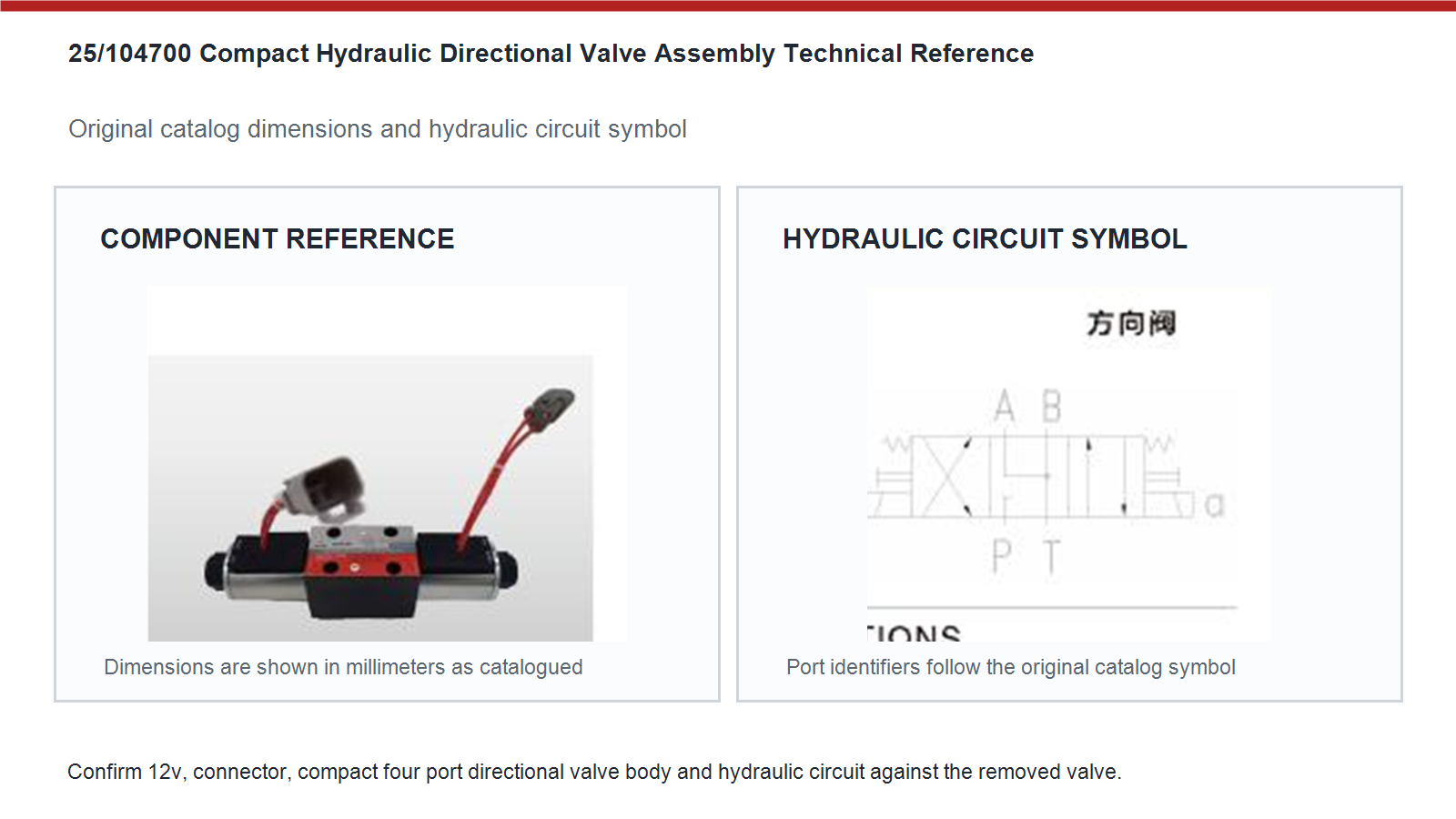
Use the original catalog dimensional reference and hydraulic symbol to compare the valve with the removed component and machine schematic before purchase approval.
Complete every control point below before a sample or bulk order is released.
Approval Point | Buyer Review |
|---|---|
Reference | 25/104700 / 25/MM6394 |
Electrical | 12V; verify at the loaded connector |
Mechanical | Compare compact four port directional valve body, sealing positions and installed clearance |
Hydraulic | Confirm normal state, energized state and port relationship |
Machine Evidence | JCB 2CX, 3CX, 4CX, loaders, telehandlers and forklifts using the compact 25/104700 assembly configuration |
Separate electrical command, component movement and final machine response so the actual wiring or hydraulic fault is not hidden by parts replacement.
Observed Condition | Recommended Check |
|---|---|
No movement | Check loaded connector voltage, ground, controller command and coil resistance. |
Slow response | Inspect oil cleanliness, filter condition, viscosity and valve movement. |
Reversed response | Stop operation and compare normal and energized port logic. |
External leakage | Inspect seals, valve surface, bore condition and seating depth. |
Repeated heating | Confirm voltage, duty cycle, connector resistance and full movement. |
When an installer measures unexpected voltage drop, keep the verified measurements and test result in the service record. Use the complete old marking, 12v electrical version, connector face, compact four port directional valve body, sealing positions and the machine hydraulic schematic. A reference alone cannot prove that the normal and energized flow paths match. Record the machine model, serial number and removed-valve photographs with the approved sample so repeat orders follow the same engineering basis.
When a buyer must approve a cross-reference, keep the verified measurements and test result in the service record. Read the voltage marking on the removed coil and measure supply at the loaded connector while the controller commands the valve. Do not infer voltage only from battery count because converters, harness changes and mixed fleets can produce another coil supply. Keep the confirmed value on the inquiry, purchase order, carton label and incoming inspection record.
When an emergency field repair is reviewed, keep the verified measurements and test result in the service record. Treat 350 bar catalog reference as a component reference that must remain within the actual circuit requirement, not as permission to ignore the machine service data. Confirm which ports see pressure in both switching states, review return pressure and verify the cavity or flange. Pressure capability cannot correct a wrong spool function, cartridge depth or manifold relationship.
When an installer measures unexpected voltage drop, keep the verified measurements and test result in the service record. Compare overall length, thread or flange position, sealing diameters and connector clearance with the removed component. Read the spring side of the hydraulic symbol as the normal state and the solenoid side as the energized state. Reconcile catalog port letters with the equipment schematic before commissioning because labels can differ between valve and machine drawings.
When a first article sample is approved, keep the verified measurements and test result in the service record. Verify commanded voltage under load, coil duty cycle, connector resistance and whether the hydraulic element reaches its intended position. Low voltage can prevent full magnetic pull, while excessive voltage or continuous energization can overheat the winding. Contamination that restricts movement can add operating stress, so correct the electrical or hydraulic cause before installing another unit.
When a sample moves into volume production, keep the verified measurements and test result in the service record. Reuse is not recommended when the service procedure specifies new seals or the old rings show flattening, cuts or heat damage. Confirm material compatibility with the hydraulic oil, clean the compact four port directional valve body and inspect the bore for scoring. Lubricate seals without twisting and follow the equipment torque procedure rather than forcing the valve past resistance.
When a distributor prepares repeat stock, keep the verified measurements and test result in the service record. The spring side of the circuit symbol defines what the machine does when electrical power is absent. That state can hold, unload, block or route pilot pressure, and the wrong selection may create movement or pump load at startup. Compare the original schematic with the catalog symbol and verify the safe normal condition before energizing the replacement.
Send the complete old marking or component evidence, confirmed voltage, machine information, clear photos, measurements and required quantity for a fitment-focused B2B quotation.