ELECDURA NETWORK

Your Whole New Supply Chain For Heavy-Duty Parts
Whatsapp:
+86 18915027366
Phone:
+86 18915027366

DHF10-232A
DHF10-232A / 25/220992
OE-Equivalent Replacement Quality
IATF 16949 / ISO 9001 / CE / RoHS
50 pcs
7 - 15 Days
12 Months
DHF10-232A / 25/220992
JCB 3CX and 4CX hydraulic service using the matching cartridge and coil version
Confirm voltage, connector, cartridge or flange dimensions, seals and hydraulic circuit before installation.
| Quantity: | |
|---|---|
DHF10-232A is a two-position, three-way hydraulic solenoid valve catalogued in 12V and 24V versions and commonly associated with JCB reference 25/220992. Separate voltage variants at quotation stage and confirm the 7/8-14 UNF cartridge, connector and port logic.
Item | Confirmed Information |
Product Type | Two-position three-way hydraulic solenoid valve |
OE / Reference Numbers | DHF10-232A / 25/220992 |
Voltage | 12V and 24V variants |
Application Scope | JCB 3CX and 4CX hydraulic service using the matching cartridge and coil version |
Electrical Version | 12V and 24V variants |
Valve Function | Two-position, three-way |
Thread | 7/8-14 UNF-2A |
Maximum Working Pressure | 350 bar |
Filtration | 25 micrometres or better |
Operating Temperature | -40 to +120 degrees Celsius |
Installation Torque | 34 to 37 Nm |
MOQ | 50 pcs |
Delivery Time | 7 - 15 Days |
Warranty | 12 Months |
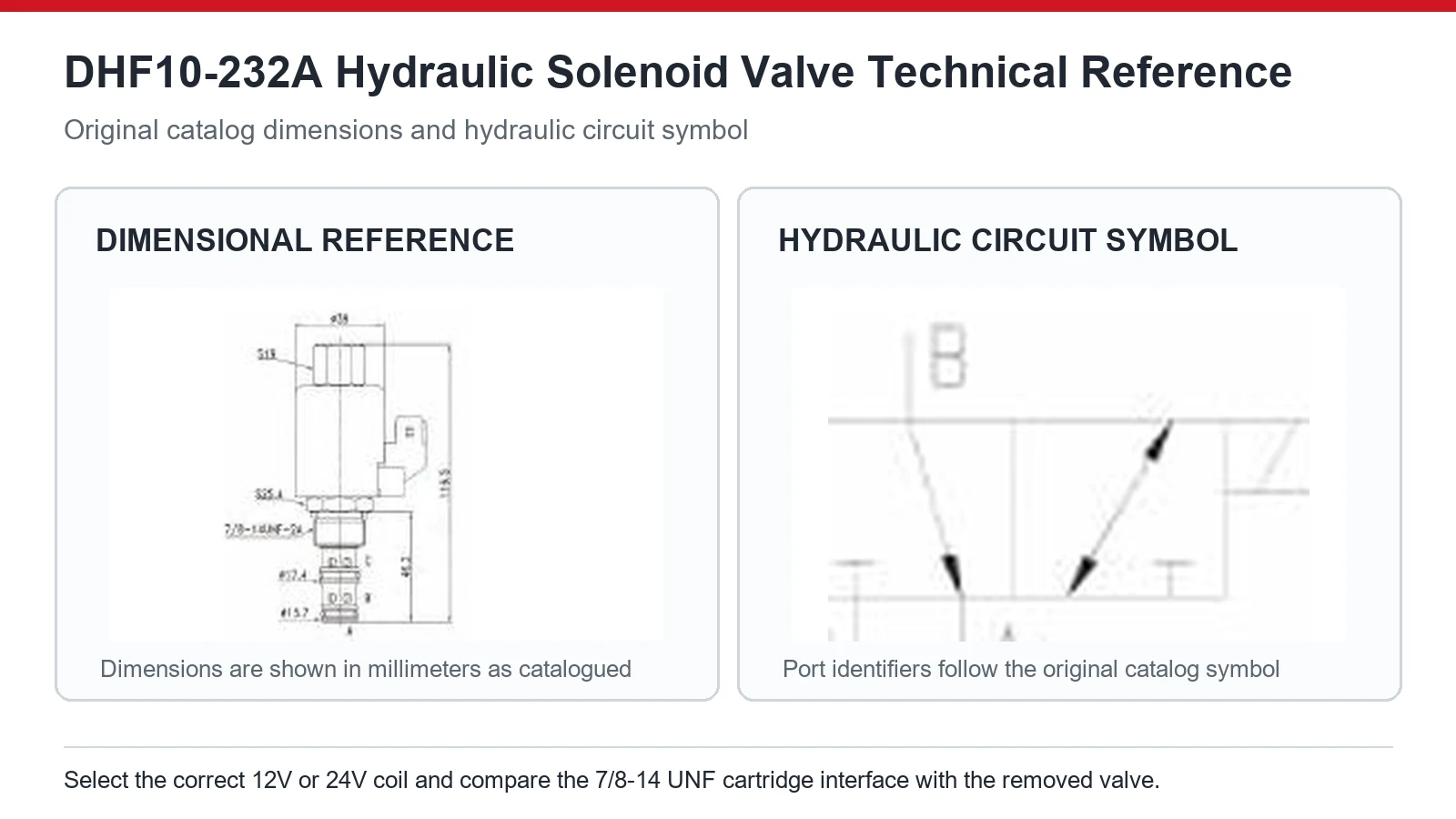
Use the DHF10-232A drawing to check 7/8-14 dimensions, sealing positions, connector space and the hydraulic symbol against the removed JCB valve.
Match DHF10-232A and 25/220992 through the selected coil voltage, 7/8-14 cartridge, sealing lands, connector and three-way hydraulic state.
Approval Point | Buyer Review |
Reference Control | DHF10-232A / 25/220992 |
Electrical Control | 12V and 24V variants; verify at the connector under command |
Mechanical Fit | Compare thread or flange, cartridge length, sealing lands and installed clearance |
Functional Control | Confirm normal state, energized state and hydraulic port relationship |
Application Evidence | JCB 3CX and 4CX hydraulic service using the matching cartridge and coil version |
If a JCB circuit reverses or fails to shift, compare command voltage, cartridge seating, port assignment and normal versus energized flow before further operation.
Observed Situation | Recommended Check |
No hydraulic response | Check command voltage, connector, coil and whether the cartridge moves. |
Slow response | Review oil cleanliness, filter condition, viscosity and connector voltage under load. |
Reversed response | Compare normal and energized circuit states with the machine schematic. |
External leakage | Inspect seals, cartridge surface, bore condition and seating depth. |
Repeated coil heating | Check voltage, resistance, duty cycle, contamination and incomplete spool movement. |
Approval Item | Required Information |
Old Part Evidence | Complete label, connector face, mounting or cartridge side and one installed view |
Machine Evidence | JCB 3CX and 4CX hydraulic service using the matching cartridge and coil version |
Measurements | Thread or flange, cartridge length, seals and installed clearance |
Electrical Evidence | 12V and 24V variants; measured under the actual command |
Commercial Evidence | Quantity, destination, packing, labeling and inspection requirements |
Check the voltage printed on the removed coil and measure supply at the connector during the actual hydraulic command. Keep DHF10-232A, 25/220992 and the confirmed voltage together on the inquiry. Similar cartridge bodies can carry different coils, so voltage must remain a controlled order and receiving field rather than an assumption from machine battery count.
Compare the complete removed marking, JCB model and serial number, connector, 7/8-14 interface, cartridge length and circuit function. A matching reference supports identification but does not waive physical review. Record both numbers only after the old unit and approved sample agree, especially when 12V and 24V versions share similar external dimensions.
Thread compatibility establishes only one part of the hydraulic interface. Sealing lands, cartridge depth and circuit geometry must also align, while the 350 bar maximum working pressure defines the required pressure capability. Approval should confirm all factors so a lower-rated or differently ported valve is not installed merely because the thread engages.
Stop operation and compare the replacement's de-energized and energized three-way paths with the removed valve and JCB schematic. Check cartridge orientation, valve-block port assignment and electrical command state. Reversed response indicates a functional mismatch or installation issue, not a condition that should be corrected by changing hoses without circuit confirmation.
Maintain filtration at 25 micrometres or better, clean the cavity and inspect seals before insertion. Start the thread by hand and apply 34 to 37 Nm with a calibrated wrench after smooth seating is confirmed. Dirt or damaged seals can create resistance that makes a correctly torqued valve appear tight before the cartridge reaches its intended depth.
Provide DHF10-232A and any visible 25/220992 reference, measured coil voltage, machine model and serial number, connector face, cartridge and seal photographs, thread and overall dimensions, quantity and delivery destination. Add the hydraulic symptom and old valve circuit information when available so technical matching can occur before sample dispatch.
Request a DHF10-232A quote with 25/220992, confirmed 12V or 24V rating, JCB serial data, cartridge details, quantity and destination.