ELECDURA NETWORK

Your Whole New Supply Chain For Heavy-Duty Parts
Whatsapp:
+86 18915027366
Phone:
+86 18915027366

25/105100
25/105100
OE-Equivalent Replacement Quality
IATF 16949 / ISO 9001 / CE / RoHS
50 pcs
7 - 15 Days
12 Months
25/105100
JCB 3CX and 4CX transmission and hydraulic control applications with confirmed serial compatibility
Confirm voltage, connector, cartridge or flange dimensions, seals and hydraulic circuit before installation.
| Quantity: | |
|---|---|
25/105100 is a 12V hydraulic solenoid valve for JCB service, with the catalog showing a two-position, three-way circuit and 7/8-14 UNF cartridge. Specialist JCB parts sources list the reference as a solenoid valve, while the exact transmission or hydraulic function must be checked by machine serial number.
Item | Confirmed Information |
Product Type | Two-position three-way hydraulic solenoid valve |
OE / Reference Numbers | 25/105100 |
Voltage | 12V |
Application Scope | JCB 3CX and 4CX transmission and hydraulic control applications with confirmed serial compatibility |
Electrical Version | 12V |
Valve Function | Two-position, three-way |
Thread | 7/8-14 UNF-2A |
Maximum Working Pressure | 350 bar |
Filtration | 25 micrometres or better |
Operating Temperature | -40 to +120 degrees Celsius |
Installation Torque | 34 to 37 Nm |
MOQ | 50 pcs |
Delivery Time | 7 - 15 Days |
Warranty | 12 Months |
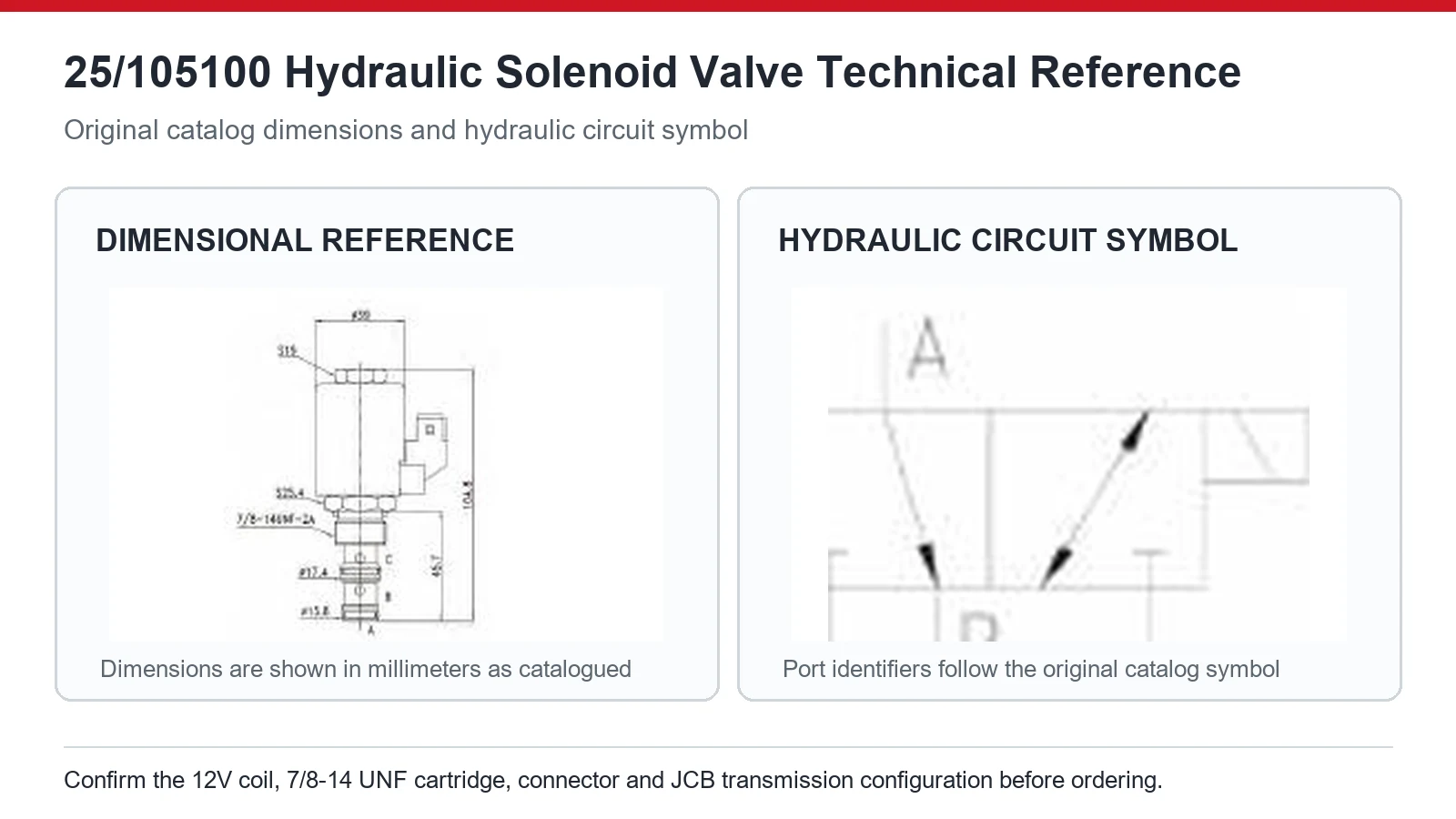
Use the 25/105100 dimensional and hydraulic image to compare cartridge seating, seal locations and the normal and energized three-way states.
Match 25/105100 by its 12V coil, JCB serial range, 7/8-14 cartridge, sealing surfaces and the transmission or hydraulic circuit under control.
Approval Point | Buyer Review |
Reference Control | 25/105100 |
Electrical Control | 12V; verify at the connector under command |
Mechanical Fit | Compare thread or flange, cartridge length, sealing lands and installed clearance |
Functional Control | Confirm normal state, energized state and hydraulic port relationship |
Application Evidence | JCB 3CX and 4CX transmission and hydraulic control applications with confirmed serial compatibility |
A weak JCB response should be divided into electrical command, spool action, oil condition and valve-block function before the 25/105100 valve is replaced.
Observed Situation | Recommended Check |
No hydraulic response | Check command voltage, connector, coil and whether the cartridge moves. |
Slow response | Review oil cleanliness, filter condition, viscosity and connector voltage under load. |
Reversed response | Compare normal and energized circuit states with the machine schematic. |
External leakage | Inspect seals, cartridge surface, bore condition and seating depth. |
Repeated coil heating | Check voltage, resistance, duty cycle, contamination and incomplete spool movement. |
Approval Item | Required Information |
Old Part Evidence | Complete label, connector face, mounting or cartridge side and one installed view |
Machine Evidence | JCB 3CX and 4CX transmission and hydraulic control applications with confirmed serial compatibility |
Measurements | Thread or flange, cartridge length, seals and installed clearance |
Electrical Evidence | 12V; measured under the actual command |
Commercial Evidence | Quantity, destination, packing, labeling and inspection requirements |
Confirm the removed coil is marked 12V and measure supply during the actual command. Verify that the valve-block duty remains within the listed 350 bar maximum working pressure. Electrical rating and pressure capability must be approved together because a physically fitting valve with the wrong coil or hydraulic rating cannot be treated as an equivalent replacement.
A JCB 3CX or 4CX can contain several solenoid valves with similar external forms. Record the installed valve-block location, controlled function, machine serial number and removed 25/105100 marking. Identifying whether the circuit controls transmission or another hydraulic operation prevents a visually similar three-way valve from being assigned to an unsuitable position.
Compare the spring-held state and solenoid-operated state with the equipment schematic, then identify pressure, return and work ports in the actual block. Check the removed valve whenever port labels are unclear. A correct 7/8-14 cartridge and 12V coil can still create reversed action if the internal three-way circuit differs.
Depressurize and clean the cavity, inspect the bore, lubricate compatible seals and start the cartridge by hand. Confirm smooth seating before applying 34 to 37 Nm with a calibrated torque wrench. Never use torque to force damaged threads or contaminated seals into position, because leakage and cartridge distortion may follow.
Low command voltage, connector resistance, contaminated oil, restricted passages, damaged seals and a sticking machine spool can all reduce response. Check filtration at 25 micrometres or better and compare electrical input with hydraulic output. A controlled diagnosis prevents repeated replacement when the real problem lies in wiring, oil condition or the valve block.
Confirm the reference, 12V marking, connector key, 7/8-14 interface, cartridge measurements, seals and circuit configuration against the approved JCB sample. Sample resistance and actuation by lot, and protect sealing surfaces during packing. Store the units with the approved 3CX or 4CX serial group rather than under a broad hydraulic valve label.
Send 25/105100, the JCB model and serial number, 12V confirmation, connector and cartridge photographs, circuit location, quantity and packing request.