ELECDURA NETWORK

Your Whole New Supply Chain For Heavy-Duty Parts
Whatsapp:
+86 18915027366
Phone:
+86 18915027366


STN7109
STN7109
Elecdura
Available for qualified orders
20 pcs
7 - 15 Days
Neutral packaging / private-label review
18 Months
STN7109
Hino commercial and industrial applications using EC100 or EH100 engines
Confirm 12V, 2.5kW, 11T, CW, 3 × Ø14 mounting holes, Ø95 drive-end locating reference, 28 mm and 18 mm axial references, mounting orientation and terminal layout against the removed starter before volume supply.
| Quantity: | |
|---|---|
STN7109 serves buyers supporting Hino EC100 or EH100 engines when the short reference alone does not describe the housing. A useful inquiry combines the engine plate, 12V 2.5kW rating, 11-tooth drive and clear photographs of the removed starter.
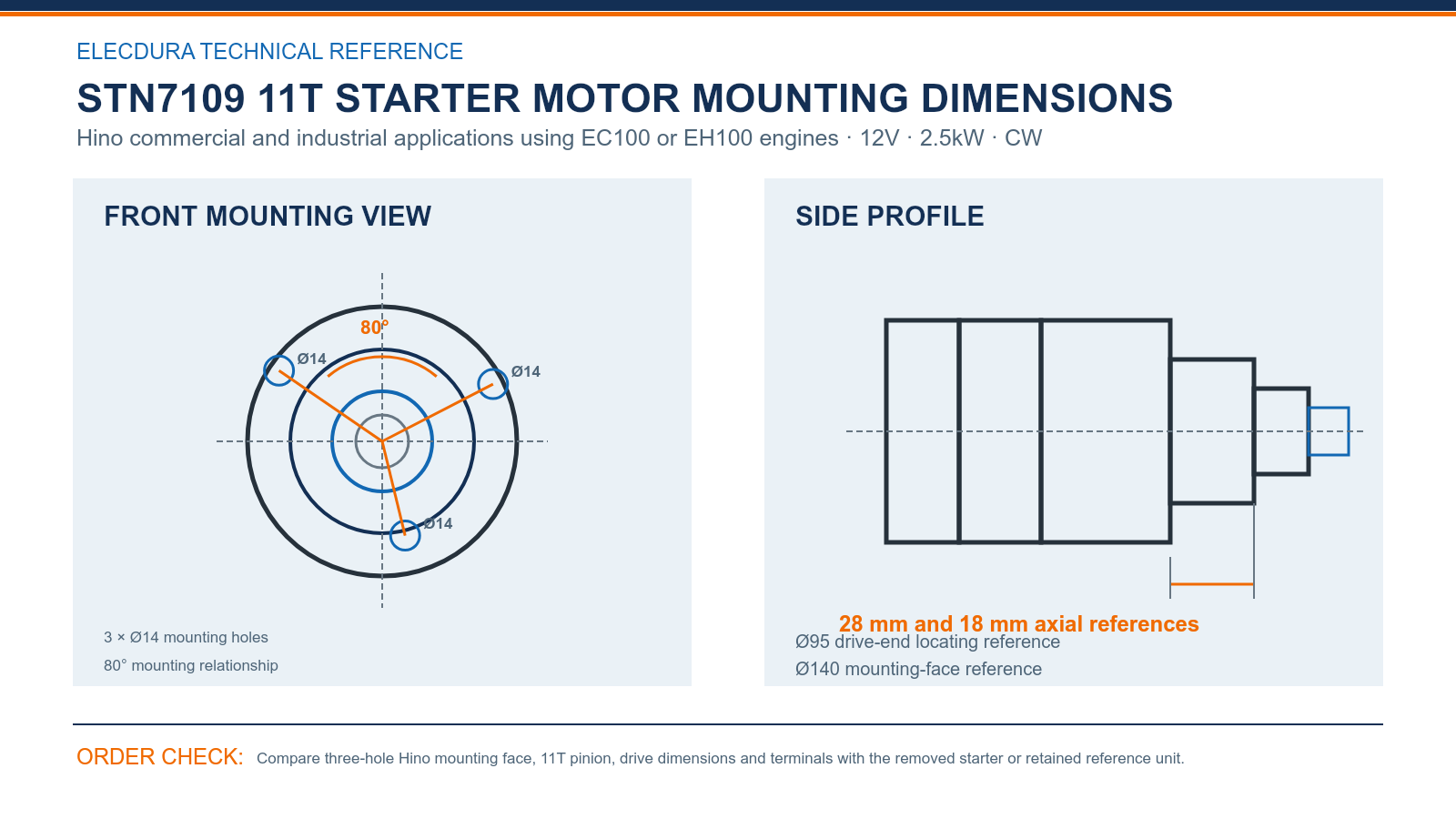
Elecdura reviews the Ø140 three-hole face, Ø95 locating reference, 80° relationship, axial dimensions and terminal side. These checks give an engine-parts wholesaler measurable fitment points for the first installation and future orders.
Primary OE reference | STN7109 |
Target application | Hino commercial and industrial applications using EC100 or EH100 engines |
Voltage and output | 12V / 2.5kW |
Pinion, module and rotation | 11 teeth / module 3 / CW |
Mounting-hole reference | 3 × Ø14 mounting holes; 80° mounting relationship |
Drive-end reference | Ø95 drive-end locating reference; 28 mm and 18 mm axial references; Ø140 mounting-face reference |
OE and cross-reference group | STN7109 |
Wholesale terms | MOQ 20 pcs / normally 7–15 days after order confirmation |
Warranty | 18 months under agreed sales terms |
STN7109 11T starter motor mounting and drive-end dimensions for buyer-side comparison.
Hino EC100 and EH100 applications use a large three-hole drive end that should be measured before quotation. Compare 3 × Ø14 mounting holes, Ø140 mounting-face reference, Ø95 drive-end locating reference, 28 mm and 18 mm axial references and 80° mounting relationship with the removed starter.
A straight mounting photograph should show all three holes, while a second image should show the 11-tooth drive and terminal clocking. Linking those checks to the engine plate gives commercial-vehicle buyers a dependable basis for ordering STN7109.
Measure the three Ø14 holes and Ø95 locating feature, then compare the 28 mm and 18 mm axial references with the removed starter. A straight face image and a terminal-side image are essential because the short market number does not describe housing clocking or cable clearance.
State whether the engine is EC100 or EH100 and include the equipment or vehicle in which it operates. If another reference appears on the label, preserve it in the RFQ so the supplier can keep separate physical variants from being merged under the STN7109 search term.
A commercial workshop group can verify a trial unit on one identified Hino engine before ordering service stock. Neutral cartons are available for routine supply; customer branding can be reviewed after volume, artwork and technical label requirements are defined.
Fitment: confirm the large three-hole face and terminal clearance.
Operation: check clean engagement, release and cranking performance.
Receiving: compare the 11-tooth pinion, terminals and electrical label across cartons so later STN7109 orders match the confirmed Hino application.
The video presents Elecdura starter-motor assembly and testing. Send the EC100 or EH100 engine plate, complete old-unit information, mounting photographs, quantity and destination so the reply can state the defined STN7109 configuration and wholesale terms.
The EC100 or EH100 engine identity provides essential application context for the short STN7109 reference. Photograph the engine plate and removed starter label together with the machine or vehicle model. This lets Elecdura compare one defined configuration and reduces the risk of selecting a similar Hino starter solely because its body looks familiar.
Record the complete additional number and include it in the RFQ without replacing STN7109. Then compare voltage, output, 11 teeth, rotation, mounting face and terminals. The extra number may improve identification, but it may also reveal that a rebuilt or later starter has been installed, so the physical unit should remain the final comparison reference.
Measure all three holes, their center relationships and the Ø95 locating feature on the removed unit. Compare these values with the Ø140 face and 80° orientation shown in the technical drawing. A straight-on image supports the measurements. This combination is more reliable than comparing the motor shell or solenoid from an angled photograph.
The 28 mm and 18 mm references help show where the drive sits relative to the mounting face and locating feature. Compare them with the removed starter together with the 11-tooth pinion. A mismatch can affect ring-gear engagement even when the bolt pattern aligns, leading to noise, incomplete cranking or accelerated drive wear.
Check that the locating face seats fully, all three bolts align without force, terminals clear surrounding parts and the pinion engages and releases cleanly. Measure cranking voltage and cable drop, and keep installation photographs. These results help the workshop separate a product issue from battery, wiring or engine condition and support consistent repeat orders.
Keep the Hino engine type, equipment application, full old-unit number, face and terminal photographs and dimensional checks together with the confirmed installation result. This gives sales staff more than a short reference and lets later customer requests be compared before stock is released, reducing the risk of mixing a different Hino housing into the order.
Select cartons from different positions and verify full labels, eleven teeth, the three-hole face, solenoid clocking, terminals and protective packaging. Compare one selected unit with the measurements confirmed on the identified Hino engine and note the lot. Isolate any item with another face or rating before it reaches service stock.
Send STN7109, the EC100 or EH100 plate, machine or vehicle model, old-unit photographs, quantity, destination, required date and packaging preference. State whether a trial unit is needed. Elecdura can then quote the specified 12V 2.5kW 11T product and provide MOQ, normal lead time and warranty terms.
Send STN7109, the Hino EC100 or EH100 engine details, equipment model, old-unit label, mounting, pinion and terminal photographs, quantity and destination. Elecdura will quote the 12V 2.5kW 11T unit with measurable fitment points, packaging and delivery terms.
If more than one Hino engine or machine group is included, separate the photos and quantities by application. Elecdura can preserve each physical identity instead of building stock around a single short market number.